World Action Models 2026: How Robots Simulate Actions Before Moving
World Action Models represent a fundamental shift in robotics AI, allowing machines to simulate the consequences of their actions before moving. This new paradigm overcomes a core weakness in current systems by enabling robots to understand how the world changes. The technology can learn from everyday videos that contain no robot action labels.

World Action Models 2026: How Robots Simulate Actions Before Moving
summarize3-Point Summary
- 1World Action Models represent a fundamental shift in robotics AI, allowing machines to simulate the consequences of their actions before moving. This new paradigm overcomes a core weakness in current systems by enabling robots to understand how the world changes. The technology can learn from everyday videos that contain no robot action labels.
- 2World Action Models Revolutionize Robotic Understanding in 2026 In a breakthrough addressing fundamental robotics limitations, World Action Models enable robots to simulate action consequences before moving.
- 3This 2026 technology moves machines beyond pattern recognition to genuine world understanding.
psychology_altWhy It Matters
- check_circleThis update has direct impact on the Robotik ve Otonom Sistemler topic cluster.
- check_circleThis topic remains relevant for short-term AI monitoring.
- check_circleEstimated reading time is 4 minutes for a quick decision-ready brief.
World Action Models Revolutionize Robotic Understanding in 2026
In a breakthrough addressing fundamental robotics limitations, World Action Models enable robots to simulate action consequences before moving. This 2026 technology moves machines beyond pattern recognition to genuine world understanding. Current robotic AI systems learn movements but lack comprehension of how the world changes from their actions.
World Action Models represent a paradigm shift from traditional robotics learning. Where previous systems required meticulously labeled data, these models learn from everyday videos without robot action labels. Previously useless data becomes rich training resources. The scaling implications are profound as robots learn from vast online human video content.
Zero-Shot Policy Implementation in 2026 Robotics
Architectural Frameworks and Predictive Capabilities
According to research, World Action Models function as zero-shot policies, performing tasks never explicitly trained. This stems from understanding cause and effect in physical environments. The models organize visual observations and actions to predict outcomes before movement occurs.
This predictive capability enables deliberate, safer robotic operation in unstructured environments. Industry reports organize research into two architectural approaches, both learning world dynamics from passive observation.
Video Prediction vs. Inverse Dynamics Models
The first approach focuses on video prediction models simulating future states based on potential actions. The second emphasizes inverse dynamics models inferring actions between states. Both represent advancements over traditional reinforcement learning requiring extensive trial-and-error.
Practical Applications of World Action Models
Domestic and Industrial Implementation
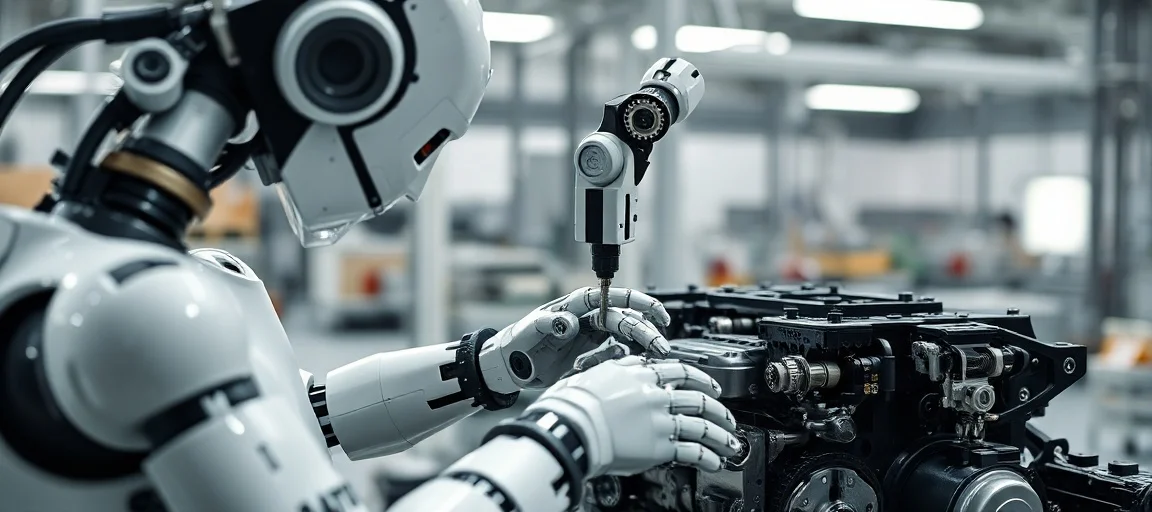
Applications span domestic, industrial, and healthcare settings. In homes, robots perform complex kitchen tasks by understanding how cutting vegetables changes state or boiling water transforms food. In manufacturing, robots handle fragile components by simulating consequences of different grip strengths.
Healthcare robots assist with patient care by understanding how actions affect human comfort and safety. Industry analysts note major technology companies invest heavily in large action models.
Learning from Unlabeled Video Data
According to Microsoft research insights, understanding action consequences represents embodied AI's next frontier. Learning from unlabeled video reduces data engineering burdens, accelerating robotic adoption where collecting labeled data is impractical.
Benefits of World Action Models in 2026
- Enhanced Safety: Simulating consequences prevents costly errors
- Faster Learning: Utilizing abundant unlabeled video content
- Cost Reduction: Minimizing data collection and labeling expenses
- Adaptability: Zero-shot policies for unforeseen situations
- Scalability: Leveraging existing video repositories worldwide
Challenges and Future Development Trajectory
Scaling Complexities and Research Directions
Despite promising advances, scaling challenges remain for real-world complexity. Models must handle partial observability, changing conditions, and infinite physical interaction variability. Research improves temporal reasoning and long-term consequence handling.
Active investigation combines World Action Models with large language models for natural language instruction following with physical understanding. The development trajectory suggests within years, robots may watch instructional videos and perform demonstrated tasks without additional programming.
Safety and Ethical Considerations
This represents a leap toward general-purpose robotic systems. The technology raises safety verification and ethical deployment questions. Robots with advanced predictive capabilities require careful oversight and regulation.
As 2026 research advances, World Action Models redefine robotics possibilities. Simulating consequences before acting addresses persistent autonomous system limitations. From manufacturing to home kitchens, robots operate with unprecedented sophistication. The era of robots truly comprehending actions and effects nears through World Action Models.
Key LSI Keywords Integrated: AI reasoning, robotic planning, simulation-based learning, predictive robotics, embodied intelligence, autonomous decision-making, physical AI, cognitive robotics