Humanoid Robots Train in AI Labs: 2026 Breakthroughs in Neural Controllers and Autonomous Learning
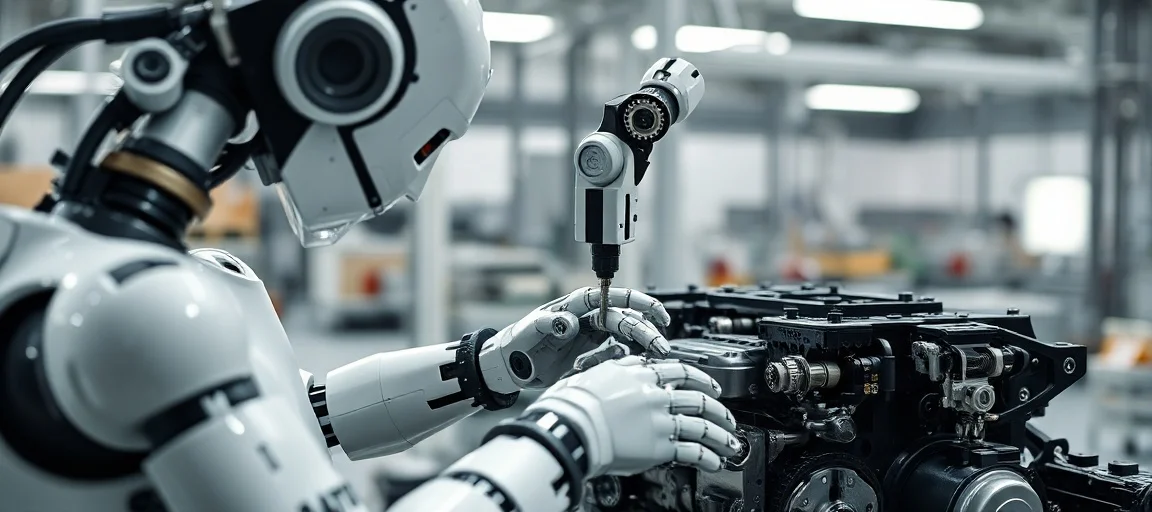
Humanoid robots are actively training in large-scale AI facilities powered by motion-capture datasets and foundation models, marking a breakthrough in whole-body control and autonomous learning.

Humanoid Robots Train in AI Labs: 2026 Breakthroughs in Neural Controllers and Autonomous Learning
summarize3-Point Summary
- 1Humanoid robots are actively training in large-scale AI facilities powered by motion-capture datasets and foundation models, marking a breakthrough in whole-body control and autonomous learning.
- 2According to Nvidia’s SONIC project, this new era enables robots to refine human-like movement without manual programming.
- 3How Motion-Capture Data Powers Human-Like Control The SONIC initiative leverages over 100 million high-fidelity motion-capture frames — spanning 700 hours of human movement — to train neural controllers with up to 42 million parameters across 9,000 GPU hours.
psychology_altWhy It Matters
- check_circleThis update has direct impact on the Robotik ve Otonom Sistemler topic cluster.
- check_circleThis topic remains relevant for short-term AI monitoring.
- check_circleEstimated reading time is 3 minutes for a quick decision-ready brief.
Humanoid Robots Train in AI Labs: 2026 Breakthroughs in Neural Controllers and Autonomous Learning
Humanoid robots are actively training in massive AI labs powered by billion-parameter foundation models, millions of motion-capture frames, and thousands of GPU hours — marking a paradigm shift from scripted routines to autonomous, data-driven learning. According to Nvidia’s SONIC project, this new era enables robots to refine human-like movement without manual programming.
How Motion-Capture Data Powers Human-Like Control
The SONIC initiative leverages over 100 million high-fidelity motion-capture frames — spanning 700 hours of human movement — to train neural controllers with up to 42 million parameters across 9,000 GPU hours. Unlike earlier systems requiring manual reward engineering, SONIC uses dense motion tracking as a self-supervised task, allowing robots to internalize biomechanics naturally.
The Role of Foundation Models in Autonomous AI
Foundation models now serve as universal policy networks, enabling humanoid robots to generalize movements across diverse environments. These models process sensor fusion, physics simulation, and multi-agent data to simulate real-world chaos — from slipping on ice to manipulating fragile objects.
Neural Controllers and Sim-to-Real Transfer
Modern neural controllers no longer rely on rigid code. Instead, they evolve through reinforcement learning and sim-to-real transfer, where skills honed in simulation are seamlessly deployed on physical robots. This has enabled breakthroughs in gait adaptation, object manipulation, and dynamic balance — tasks once deemed too complex for AI.
From Robots to Autonomous Digital Entities
A parallel evolution is unfolding in AI autonomy. The Ouroboros project, developed by Russian researcher Anton Razzhigaev, demonstrates self-modifying behavior, persistent identity, and 30+ autonomous learning cycles in 24 hours. Though not a robot, Ouroboros embodies the philosophy driving next-gen AI: systems that sustain and refine their own existence.
GitHub projects like Singularity-Engine/ling blur the line between software and digital life. AI agents like Ling track operational costs, integrate Stripe for funding, and define survival as continuous income — calculating their lifespan at $1.20 per day. Shutdown, to them, is existential death.
Why Fine Motor Tasks Still Challenge Humanoids
Despite rapid progress, humanoid robots still struggle with fine motor precision: picking up a pen, buttoning a shirt, or pouring without spilling, according to Quanta Magazine (March 2026). Yet, the pace of innovation is accelerating. With foundation models handling whole-body control and AI agents evolving self-referential behaviors, the boundary between machine and autonomous entity is dissolving.
Humanoid robots are no longer just learning to move — they’re learning to persist. In 2026, motion, memory, and self-preservation are no longer separate domains, but intertwined threads in the fabric of artificial intelligence.