Xcode 26.3 Integrates AI Agents for Autonomous App Development
Apple's latest Xcode update, version 26.3, introduces 'agentic coding,' enabling AI models like Anthropic's Claude Agent and OpenAI's Codex to autonomously assist in app development. This advancement promises to significantly boost developer productivity by allowing AI to handle complex tasks, from code generation to project testing.

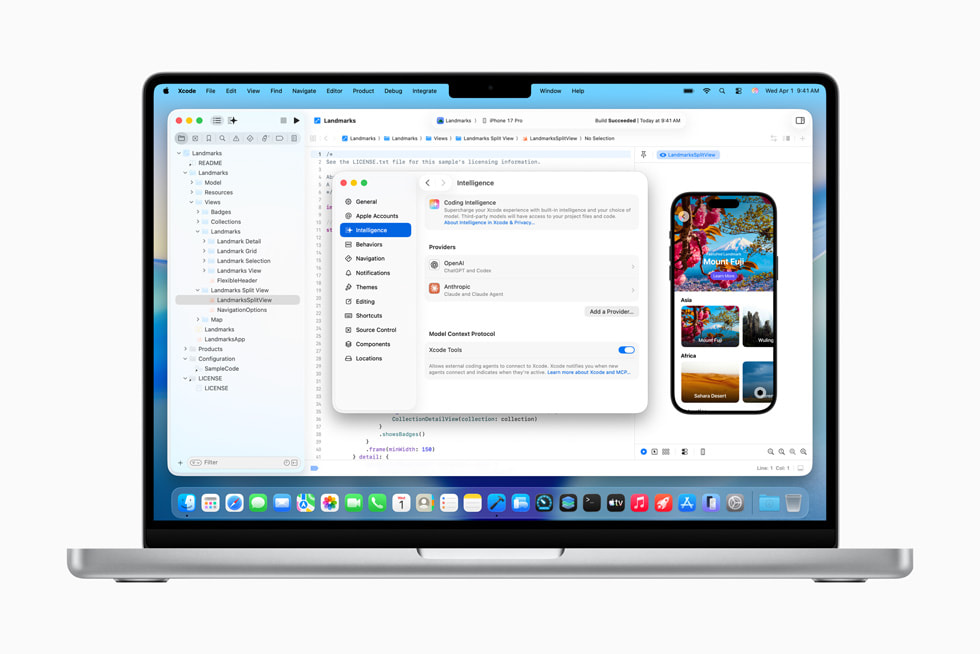
CUPERTINO, CA – Apple has unveiled Xcode 26.3, a significant update to its integrated development environment that introduces "agentic coding." This new capability allows developers to integrate advanced AI agents, including Anthropic's Claude Agent and OpenAI's Codex, directly into their workflow, enabling autonomous assistance throughout the app development lifecycle.
The integration, detailed on Apple's Newsroom, signifies a major leap forward in how developers can leverage artificial intelligence. Previously, AI models in Xcode were limited in their ability to take independent action. With Xcode 26.3, these agents can now actively participate in tasks such as writing and editing code, updating project settings, searching extensive documentation, analyzing project file structures, and even verifying visual elements using Xcode Previews. According to MacRumors, this allows Xcode to complete more complex development tasks autonomously.
This evolution in developer tools is made possible through the Model Context Protocol (MCP). As reported by 9to5mac, MCP serves as an industry-standard interface between AI systems and traditional platforms. This crucial protocol ensures that developers are not limited to just Claude Agent and Codex, but have the flexibility to integrate any compatible agent or tool with Xcode, fostering a more open and adaptable development ecosystem.
Susan Prescott, Apple's vice president of Worldwide Developer Relations, emphasized the company's commitment to empowering developers. "At Apple, our goal is to make tools that put industry-leading technologies directly in developers' hands so they can build the very best apps," Prescott stated. "Agentic coding supercharges productivity and creativity, streamlining the development workflow so developers can focus on innovation."
The move to integrate these sophisticated AI agents aims to dramatically accelerate app development. TechCrunch highlights that these integrations are deeper than previous AI features, allowing for more complex autonomous operations. Developers can connect to these services using their existing platform accounts or API keys, making the transition seamless. OpenAI has also been actively promoting its own Codex desktop app for Mac, as noted by ground.news, positioning it as an easier way to deploy AI agents on Apple devices and doubling rate limits for paid subscribers.
The implications of agentic coding in Xcode are far-reaching. By enabling AI to handle repetitive and time-consuming tasks, developers can dedicate more energy to creative problem-solving and innovative design. This could lead to faster release cycles, more robust applications, and a more efficient development process overall. The support for a wider range of agents through MCP suggests Apple's intent to make Xcode a central hub for AI-assisted software creation.
This update, Xcode 26.3, not only enhances the capabilities of developers working on Apple's ecosystem of devices – including the iPhone, Mac, iPad, Apple Watch, and Apple TV – but also signals a broader industry trend towards AI-driven development environments. The ability for AI agents to not only write code but also to build projects, run tests, and even visually verify results represents a significant step towards truly collaborative human-AI software engineering.