Purdue Scientist Enhances Robot-Human Interactions for Real-World Help
Purdue University computer scientist Sooyeon Jeong is pioneering advancements in robot communication, aiming to create more helpful and human-friendly AI companions. Her research focuses on nonverbal cues and emotional intelligence to bridge the gap between humans and artificial intelligence.

Purdue Scientist Pioneers Empathetic Robots for Enhanced Human Assistance
WEST LAFAYETTE, Ind. – The science fiction dream of friendly, helpful robots is inching closer to reality thanks to the groundbreaking work of Sooyeon Jeong, an assistant professor of computer science at Purdue University. Jeong is leading a research initiative focused on making robots and AI agents more socially adept, better listeners, and ultimately, more human-friendly in practical, real-world applications.
Drawing inspiration from beloved fictional characters like R2-D2, WALL-E, and Baymax—robots known for their emotional depth, ability to communicate beyond words, and empathetic natures—Jeong's lab is dedicated to imbuing nonfictional robots with similar qualities. Her research operates at the critical intersection of human behavior and artificial intelligence, with the overarching goal of developing robots that can genuinely improve human lives.
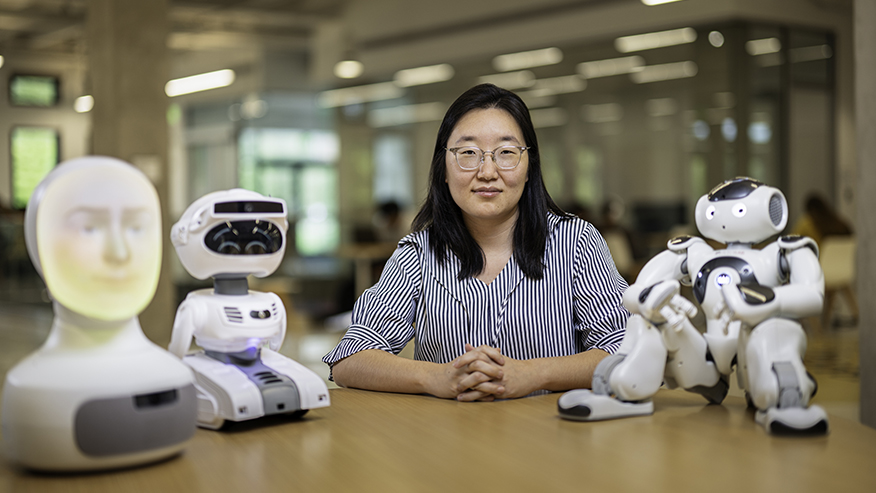
Unlike many robots that have been showcased at tech events, often remaining as novelties, Jeong's work aims for tangible impact. Her research has already demonstrated potential applications in assisting vulnerable populations. According to Purdue University news, her efforts have contributed to aiding cancer patients, individuals with aphasia, hospitalized children, and geriatric adults, highlighting the direct benefits of more sophisticated human-robot interaction.
The advancement of robots in society is a topic gaining significant traction. Reports from outlets like CNET indicate a growing trend towards "physical AI," with a surge in robot development poised to move beyond mere prototypes. CNET journalist Katie Collins noted at CES 2026 that while many robots displayed at such events often lack substantial long-term impact, the current wave suggests a shift towards more functional and integrated robotic assistance.
Jeong's approach emphasizes understanding and replicating human nonverbal communication. This focus is crucial because, as observed with fictional robots, even rudimentary communication like beeps and bloops can convey complex emotions and intentions. By teaching robots to interpret and generate more nuanced social cues, Jeong's team is building a foundation for more intuitive and supportive interactions.
The broader field of artificial intelligence is also seeing rapid evolution, with new developments constantly emerging. TechXplore recently reported on innovations like new light-emitting artificial neurons designed to enhance the reliability of AI systems, suggesting a parallel drive towards more sophisticated and efficient AI components. This technological backdrop underscores the significance of Jeong's work in human-robot interaction, as it directly addresses how these advanced AI capabilities will be integrated into human society.
The development of robots that can effectively collaborate with and support humans is a complex challenge. However, Jeong's dedication to studying robot communication and behavior at Purdue University is paving the way for a future where robots are not just tools, but trusted and helpful companions. This research, as highlighted by Purdue University, is a significant step towards realizing the potential of robotics to positively impact diverse areas of human life.
The field of robotics is constantly abuzz with new discoveries. For instance, Robotics.ee has featured innovations such as programmable, Lego-like materials for robots that emulate life's flexibility, pointing to advancements in the physical capabilities of robots. This, coupled with the push for more intelligent and communicative AI, creates a fertile ground for Jeong's research on enhancing the social and emotional intelligence of robots.
Ultimately, Jeong's work at Purdue University is more than just academic research; it's a mission to create robots that are not only functional but also empathetic and beneficial to human well-being. By focusing on the intricate dynamics of human-robot communication, she is helping to shape a future where robots can indeed be trusted partners in everyday life.