Hitachi IWIM Physical AI: Self-Learning Robots Transform Industrial Automation in 2026
Hitachi unveils its Physical AI model IWIM, deploying two prototype robots that learn and optimize tasks autonomously in real-world environments. This breakthrough merges machine learning with physical systems, marking a major leap in industrial automation.

Hitachi IWIM Physical AI: Self-Learning Robots Transform Industrial Automation in 2026
summarize3-Point Summary
- 1Hitachi unveils its Physical AI model IWIM, deploying two prototype robots that learn and optimize tasks autonomously in real-world environments. This breakthrough merges machine learning with physical systems, marking a major leap in industrial automation.
- 2Hitachi IWIM Physical AI: Self-Learning Robots Transform Industrial Automation in 2026 Hitachi has unveiled IWIM (Integrated Workforce Intelligence Model), a groundbreaking Physical AI system that’s redefining factory automation in 2026.
- 3Unlike traditional robots, IWIM learns autonomously from real-world environments using sensory feedback, computer vision, and reinforcement learning — no pre-programmed instructions needed.
psychology_altWhy It Matters
- check_circleThis update has direct impact on the Robotik ve Otonom Sistemler topic cluster.
- check_circleThis topic remains relevant for short-term AI monitoring.
- check_circleEstimated reading time is 3 minutes for a quick decision-ready brief.
Hitachi IWIM Physical AI: Self-Learning Robots Transform Industrial Automation in 2026
Hitachi has unveiled IWIM (Integrated Workforce Intelligence Model), a groundbreaking Physical AI system that’s redefining factory automation in 2026. Unlike traditional robots, IWIM learns autonomously from real-world environments using sensory feedback, computer vision, and reinforcement learning — no pre-programmed instructions needed.
How IWIM Learns Without Programming
IWIM leverages edge computing to simulate thousands of operational scenarios in real time, adapting its behavior through continuous feedback loops. Trained on anonymized field data from partner factories, the AI model refines tasks like grip strength, torque control, and path planning without human intervention.
This embodied AI approach — where machines learn through physical interaction — mirrors advances in collaborative robotics and sets Hitachi apart from competitors relying on static code.
Real-World Applications in Smart Factories
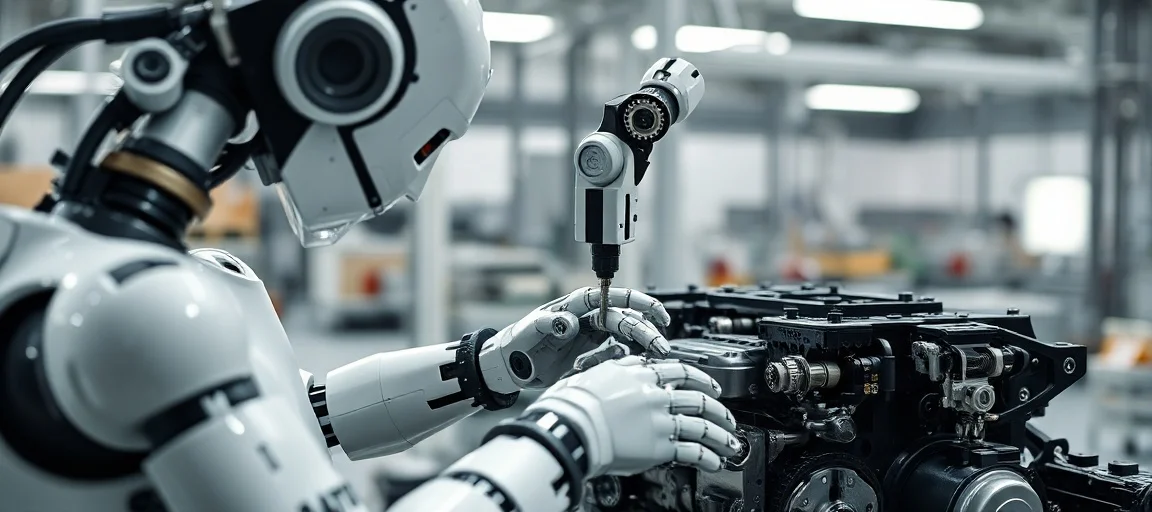
At Hitachi’s Kashiwa Plant, two IWIM-powered prototypes demonstrated transformative results: a multi-arm logistics bot that reconfigured grips mid-task for irregular objects, and a collaborative assembly assistant that adjusted sequencing based on worker proximity and tool wear.
Early trials show a 40% reduction in task completion time and a 30% drop in error rates — proving IWIM’s value in automotive, electronics, and pharmaceutical manufacturing.
AI-Driven Predictive Maintenance & Digital Twin Integration
IWIM’s real-time adaptation capabilities extend beyond task execution. By analyzing vibration, temperature, and wear patterns, the system predicts equipment failures before they occur — enabling predictive maintenance and reducing unplanned downtime.
Hitachi is also integrating IWIM with digital twin simulations, allowing factories to test robotic workflows in virtual environments before deployment, accelerating scalability across global supply chains.
Human-Centered Automation: Augmenting, Not Replacing
Workers at pilot sites report increased safety and reduced physical strain. IWIM is designed as a collaborative partner, handling repetitive or hazardous tasks while humans focus on oversight and complex decision-making.
This human-centric philosophy positions IWIM not as a replacement, but as the next evolution of Industry 4.0 — where machines learn, adapt, and collaborate alongside people.
Hitachi plans to commercialize IWIM-powered systems by late 2025, with global pilots targeting cross-border logistics hubs. As demand for adaptive automation surges, IWIM is setting a new standard: intelligent, physical, and self-improving.