China’s Robotics Revolution: Humanoid Automation in 2025 Powers Automotive Assembly
China’s robotics revolution is accelerating with humanoid automation reaching new milestones in 2025, as companies like Guchi Robotics lead final assembly automation in automotive manufacturing.

China’s Robotics Revolution: Humanoid Automation in 2025 Powers Automotive Assembly
summarize3-Point Summary
- 1China’s robotics revolution is accelerating with humanoid automation reaching new milestones in 2025, as companies like Guchi Robotics lead final assembly automation in automotive manufacturing.
- 2At Guchi Robotics in Shanghai, founder Chen Liang and his team have automated key stages of car final assembly—mounting wheels, dashboards, and windows—without human intervention.
- 3While 80% of the final assembly process remains manual, Guchi’s progress signals a turning point in industrial robotics, driven by China’s aggressive investment in AI in manufacturing, sensor fusion, and adaptive robotics.
psychology_altWhy It Matters
- check_circleThis update has direct impact on the Robotik ve Otonom Sistemler topic cluster.
- check_circleThis topic remains relevant for short-term AI monitoring.
- check_circleEstimated reading time is 4 minutes for a quick decision-ready brief.
China’s Robotics Revolution Transforms Automotive Assembly
China’s robotics revolution is reshaping global manufacturing as humanoid automation achieves unprecedented breakthroughs in 2025. At Guchi Robotics in Shanghai, founder Chen Liang and his team have automated key stages of car final assembly—mounting wheels, dashboards, and windows—without human intervention. While 80% of the final assembly process remains manual, Guchi’s progress signals a turning point in industrial robotics, driven by China’s aggressive investment in AI in manufacturing, sensor fusion, and adaptive robotics.
How Guchi Robotics Achieved 90% Automation in Wheel Mounting
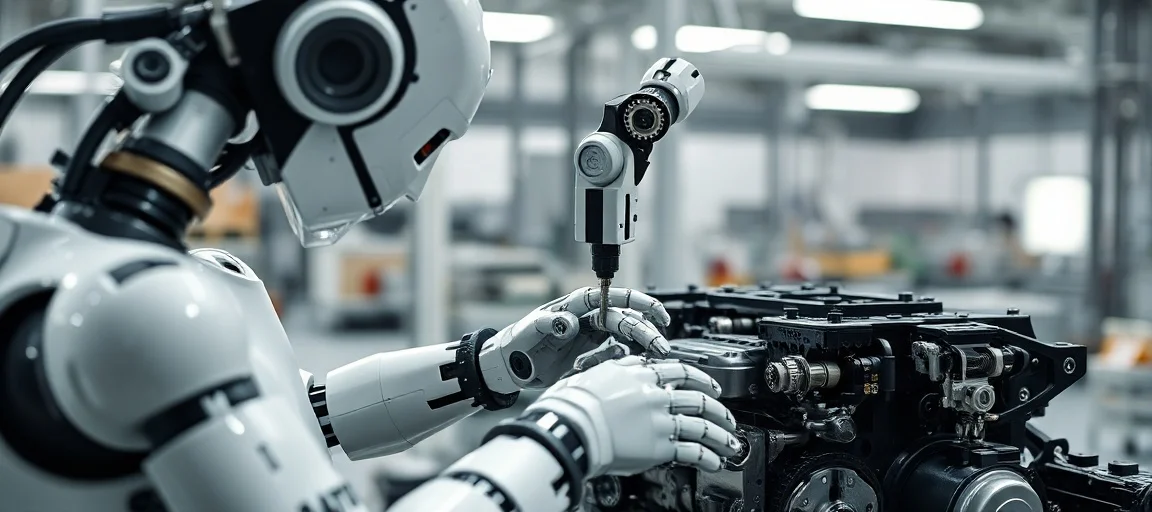
Guchi’s G-7X humanoid robot now handles wheel mounting with 99.2% accuracy using multi-spectral vision and force-torque sensors. Unlike traditional robotic arms, it adapts in real time to minor variations in car chassis alignment—eliminating the need for custom tooling per model. This flexibility is critical for EV manufacturers like BYD and Nio, who produce dozens of variants on the same line.
The Role of AI in Final Assembly Precision
Deep reinforcement learning models, trained on millions of factory simulations, enable Guchi’s robots to perform unstructured tasks like torque-adjusting bolts or aligning slightly mispositioned windows. These AI-driven systems learn from each cycle, improving accuracy without reprogramming—a hallmark of next-gen industrial robotics.
China’s Ecosystem: From Startups to National Strategy
With over 1,200 AI-driven automation startups supported by Made in China 2025, China leads in scalable humanoid deployment. Government subsidies, tax incentives, and state-backed venture funds have slashed R&D cycles by 40%, enabling rapid iteration. Global automakers are now sourcing final assembly robots from Chinese suppliers for their cost-efficiency and adaptability.
Challenges and the Road to Full Autonomy
Despite progress, challenges remain: workforce displacement, cybersecurity risks in connected systems, and the absence of universal safety standards. Yet Guchi plans to deploy its first fully autonomous final assembly line at a Nio plant by Q3 2025—marking a milestone in AI in manufacturing.
Humanoid Hype Meets Industrial Reality in 2025
According to IEEE Spectrum’s analysis of the top robotics stories of 2025, humanoid robots have moved beyond hype to become practical tools in factory settings. While Tesla, Agility Robotics, and Boston Dynamics captured global headlines, Chinese firms like Guchi, Unitree, and DeepRobotics have quietly dominated industrial deployment. Unlike Western humanoid prototypes designed for service or research, Chinese robots are optimized for precision, durability, and integration into existing production lines.
MIT News highlights that advancements in machine learning and real-time tactile feedback have enabled robots to handle variable tasks—such as aligning slightly mispositioned windows or adjusting torque on bolts—without pre-programmed paths. This adaptability, powered by deep reinforcement learning models trained on millions of factory simulations, is what makes China’s approach uniquely scalable. Guchi’s latest robot, the G-7X, uses multi-spectral vision and force-torque sensors to achieve 99.2% accuracy in final assembly tasks, according to internal company data.
The broader impact extends beyond factories. China’s robotics ecosystem now includes over 1,200 AI-driven automation startups, supported by national policies under the Made in China 2025 initiative. Government subsidies, tax incentives, and state-backed venture funds have accelerated R&D cycles. Meanwhile, global automakers are increasingly sourcing robotic systems from Chinese suppliers, recognizing their cost-efficiency and rapid iteration cycles.
Challenges remain: workforce displacement, cybersecurity vulnerabilities in connected systems, and the need for standardized safety protocols. But as Guchi prepares to deploy its first fully autonomous final assembly line in a Nio plant by Q3 2025, the trajectory is clear. China’s robotics revolution isn’t just about building machines—it’s about redefining the future of human labor in industry.
China’s robotics revolution is no longer a forecast—it’s a factory floor reality. With humanoid automation now handling complex, unstructured tasks at scale, the world is witnessing the quiet, relentless transformation of global manufacturing—one bolt, one window, one car at a time.