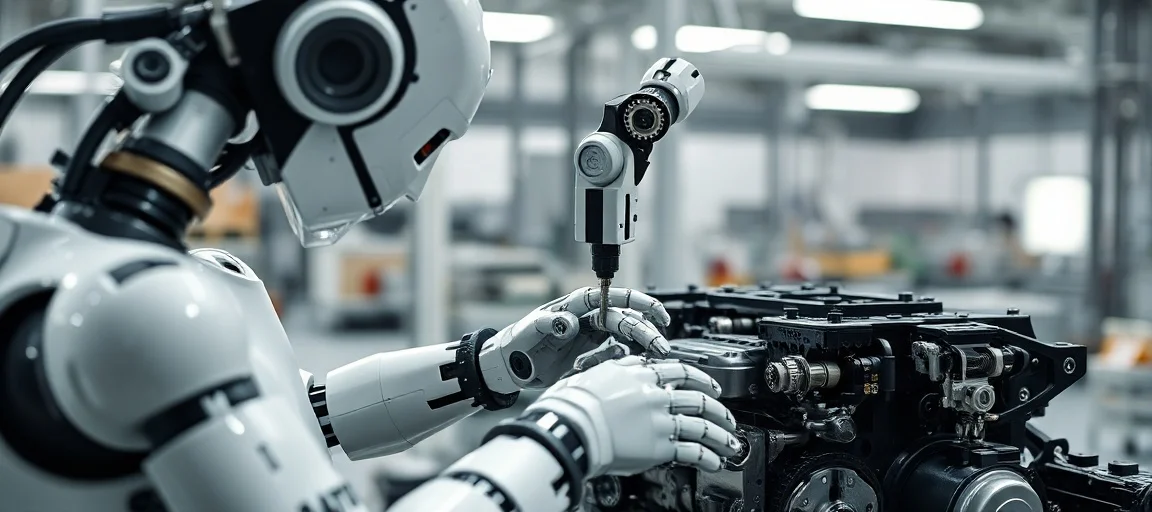
China’s Humanoid Robot Training Farms Drive 2026 AI Manufacturing Boom
China is deploying vast humanoid robot training farms to accelerate AI development, with facilities in Shanghai and Wuhan teaching robots everyday tasks through human-guided data collection. These centers are critical to the nation’s goal of leading global robotics innovation.

China’s Humanoid Robot Training Farms Drive 2026 AI Manufacturing Boom
summarize3-Point Summary
- 1China is deploying vast humanoid robot training farms to accelerate AI development, with facilities in Shanghai and Wuhan teaching robots everyday tasks through human-guided data collection. These centers are critical to the nation’s goal of leading global robotics innovation.
- 2China’s Humanoid Robot Training Farms Drive 2026 AI Manufacturing Boom China’s humanoid robot training farms are at the heart of a national push to dominate the next generation of artificial intelligence and automation.
- 3Across facilities in Shanghai, Wuhan, and beyond, teams of engineers are teaching humanoid robots to perform mundane human tasks—folding laundry, making sandwiches, brewing coffee—through intensive, data-driven simulations.
psychology_altWhy It Matters
- check_circleThis update has direct impact on the Robotik ve Otonom Sistemler topic cluster.
- check_circleThis topic remains relevant for short-term AI monitoring.
- check_circleEstimated reading time is 3 minutes for a quick decision-ready brief.
China’s Humanoid Robot Training Farms Drive 2026 AI Manufacturing Boom
China’s humanoid robot training farms are at the heart of a national push to dominate the next generation of artificial intelligence and automation. Across facilities in Shanghai, Wuhan, and beyond, teams of engineers are teaching humanoid robots to perform mundane human tasks—folding laundry, making sandwiches, brewing coffee—through intensive, data-driven simulations. These training centers, often operating 17 hours a day, generate the massive datasets required to refine machine learning models that power autonomous movement and decision-making in humanoid machines. The scale of this effort is unprecedented, with one facility producing terabytes of motion data daily.
How VR Simulations Train Robots for Real-World Dexterity
According to Reuters, AgiBot’s Shanghai warehouse hosts dozens of robots repeatedly practicing household and industrial tasks, with the goal of one day enabling robots to assemble themselves. Meanwhile, in Wuhan, as reported by Yahoo News, engineers use virtual reality headsets and motion controllers to physically guide robot limbs, mimicking human postures in real time. This immersive training method captures nuanced motor data that traditional programming cannot replicate, allowing robots to learn complex coordination through imitation and reinforcement learning.
China’s National AI Infrastructure: A Unified Ecosystem
The Chinese government has heavily subsidized this effort, funneling billions into AI startups and robotics research centers. These training farms function as hybrid labs and data factories: every stumble, movement, and successful task is logged, analyzed, and fed back into neural networks. Data is shared among state-backed research consortia, creating a unified national AI ecosystem unlike anything in the West.
Simulated Environments Accelerate Robotic Learning
Unlike Western nations focusing on specialized industrial bots, China trains robots for home, factory, and public spaces simultaneously. Simulated environments replicate everything from crowded subway stations to chaotic kitchen counters, enabling robots to develop adaptive robotic dexterity. This broad application strategy is fueling rapid progress in reinforcement learning and generalization across tasks.
AI Workforce and Ethical Implications
With labor shortages accelerating in manufacturing and services, humanoid robots are seen as a strategic solution to sustain productivity and global competitiveness. Analysts predict China could deploy over 1 million humanoid robots in industrial settings by 2027. Behind the innovation, Beijing is already debating AI unemployment insurance to mitigate workforce displacement. Yet for now, the priority remains speed, scale, and technological dominance.
As China’s humanoid robot training farms grow in number and sophistication, they are becoming the invisible engines of a new industrial revolution. The machines learning in these labs today will define tomorrow’s workplaces—and possibly, redefine what it means to be human in an age of intelligent machines.