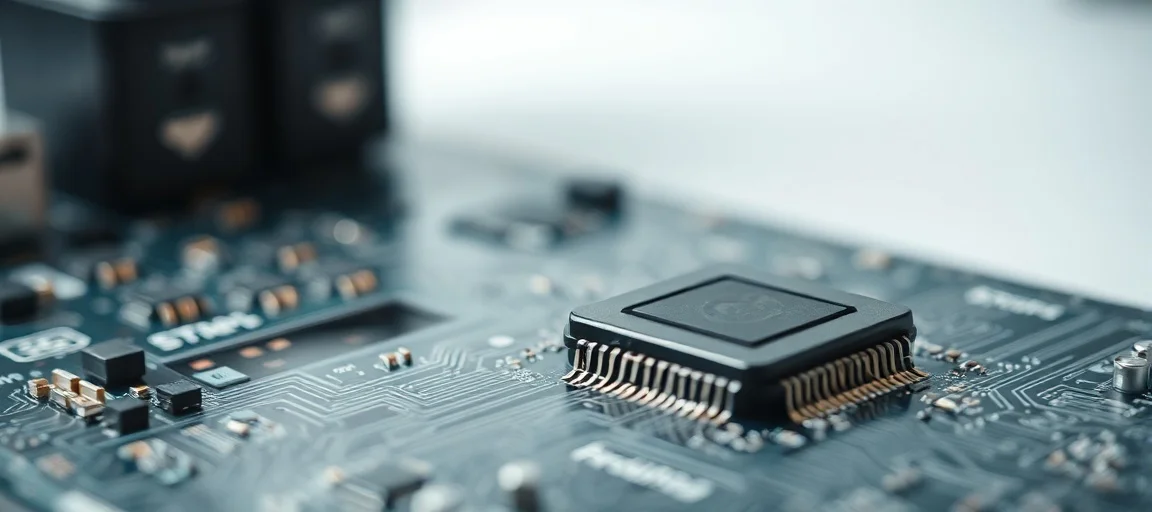
2026 Breakthrough: Heat-Resistant Chip Operates at 700°C to Revolutionize AI Computing
A revolutionary memory chip capable of operating at 700°C has been developed, shattering thermal limits in electronics and opening new frontiers for AI. This breakthrough, born from accidental discovery, enables data processing in extreme environments previously deemed impossible.

2026 Breakthrough: Heat-Resistant Chip Operates at 700°C to Revolutionize AI Computing
summarize3-Point Summary
- 1A revolutionary memory chip capable of operating at 700°C has been developed, shattering thermal limits in electronics and opening new frontiers for AI. This breakthrough, born from accidental discovery, enables data processing in extreme environments previously deemed impossible.
- 2Unlike conventional silicon chips that fail above 150°C, this breakthrough device maintains full functionality under conditions hotter than molten lava, eliminating the need for bulky cooling systems and enabling AI to operate where it was once impossible.
- 3How the 700°C Chip Works: Atomic-Level Thermal Resilience The chip uses a novel stack of oxide layers and transition metal compounds that form a self-repairing atomic lattice under extreme heat.
psychology_altWhy It Matters
- check_circleThis update has direct impact on the Bilim ve Araştırma topic cluster.
- check_circleThis topic remains relevant for short-term AI monitoring.
- check_circleEstimated reading time is 3 minutes for a quick decision-ready brief.
2026 Breakthrough: Heat-Resistant Chip Operates at 700°C to Revolutionize AI Computing
A revolutionary memory chip capable of operating at 700°C (1300°F) has been developed by researchers at POSTECH — shattering thermal limits in electronics and unlocking unprecedented potential for AI. Unlike conventional silicon chips that fail above 150°C, this breakthrough device maintains full functionality under conditions hotter than molten lava, eliminating the need for bulky cooling systems and enabling AI to operate where it was once impossible.
How the 700°C Chip Works: Atomic-Level Thermal Resilience
The chip uses a novel stack of oxide layers and transition metal compounds that form a self-repairing atomic lattice under extreme heat. This structure prevents atomic diffusion and inhibits conductive filament formation — the primary causes of failure in overheated semiconductors. Initial experiments aimed to enhance spin wave transfer for heatless computing, but researchers unexpectedly discovered that the interface materials stabilized electron states even at 700°C.
Why Silicon Fails Above 150°C — And How This Chip Overcomes It
Traditional silicon-based electronics suffer from thermal throttling, electron mobility loss, and material degradation as temperatures rise. At 150°C+, interconnects degrade, dopants migrate, and insulating layers break down. The POSTECH chip bypasses these limits using silicon carbide-inspired architectures and non-volatile memory elements that retain data without power, even under thermal cycling.
Applications in Space, Automotive, and Industrial AI
This thermal resilience opens transformative applications:
- Space Exploration: AI-powered landers and probes can process data on Venus or near-sun satellites without active cooling.
- Autonomous Vehicles: Self-driving cars in desert climates or high-performance EVs can run AI models locally in engine bays.
- Industrial Robotics: Robots in steel foundries or nuclear facilities can make real-time decisions without shutdowns.
- Data Centers: AI servers no longer need 40% of their power for cooling — slashing energy costs and carbon footprints.
Scalability and Future Roadmap
Early prototypes have passed 10,000 thermal cycles between room temperature and 700°C with zero data loss or performance degradation. The POSTECH team is now partnering with global semiconductor manufacturers to integrate the technology into existing CMOS fabrication lines, minimizing production costs and accelerating time-to-market. Commercial deployment is projected for late 2026.
Heat-resistant chips like this don’t just improve electronics — they redefine what’s physically possible. As AI systems grow more complex and demand real-time processing in hostile environments, thermal resilience may soon be as critical as processing speed. This breakthrough isn’t an upgrade — it’s a new paradigm for computing.